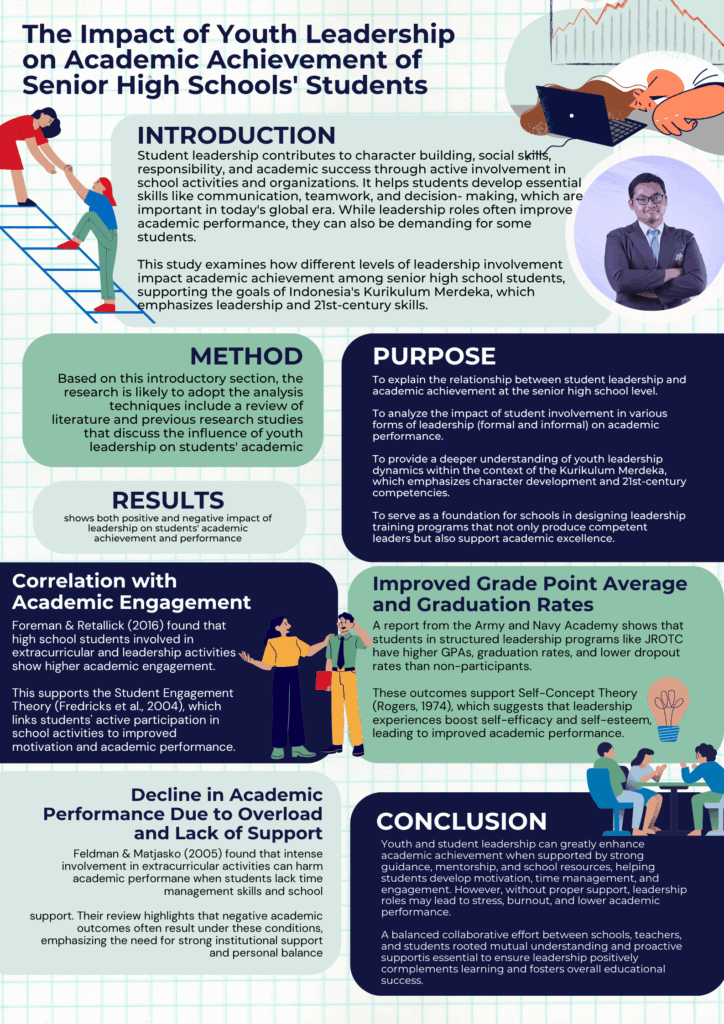
THE IMPACT OF YOUTH LEADERSHIP ON ACADEMIC ACHIEVEMENT OF SENIOR HIGH SCHOOLS’ STUDENTS
Abid Shabir Imavin, Yusril Ihza Mahendra
ABSTRACT
Student leadership plays a fundamental role in the overall development of individuals in the school environment, including the formation of strong character, sharp critical thinking skills, adaptive social skills, and a deep understanding of prevailing values and norms. This study aims to conduct an in-depth analysis of the impact of student involvement in various school organisations on their academic performance, as well as to specifically identify the unique challenges faced by students in leadership roles. Through comprehensive literature review and analysis, it was revealed that leadership experiences inherently cultivate essential soft skills, including effective time management, a strong sense of responsibility, persuasive communication skills, and constructive collaboration abilities. However, based on previous literature, it was found that some students reported difficulties in maintaining optimal academic performance due to the high organisational responsibilities and significant time demands. The findings of this literature review are expected to serve as a valuable foundation for schools in designing and implementing leadership programmes that not only aim to cultivate resilient and integrity-driven student leaders but also actively support and facilitate students’ optimal academic achievement.
Keywords: Student Leadership, Academic Achievement, School Systems, Coaching And Supervision Strategies
REFERENCE
Abbas, S. G., & Bibi, H. (2025). CHALLENGES FACED BY STUDENT LEADERS IN SECONDARY SCHOOLS : A. January. https://doi.org/10.63468/jpsa.3.1.14
Army and Navy Academy. (n.d.). How JROTC Builds Leadership and Academic Success. Retrieved April 28, 2025, from https://armyandnavyacademy.org/blog/10-benefits-of-joining-jrotc-in-high-school/
Bandura, A. (1986). Social Foundations of Thought and Action: A Social Cognitive Theory (2nd ed.). Prentice-Hall.
Deci, E. L., & Ryan, R. M. (2013). Intrinsic Motivation and Self-Determination in Human Behavior. Springer Science & Business Media.
Deng, W., Li, X., Wu, H., & Xu, G. (2019). Student leadership and academic performance. China Economic Review, 60, 101389. https://doi.org/https://doi.org/10.1016/j.chieco.2019.101389
Feldman, A. F., & Matjasko, J. L. (2005). The role of school-based extracurricular activities in adolescent development: A comprehensive review and future directions. Review of Educational Research, American Educational Research Association (AERA), 75(2), 159–210. https://doi.org/10.3102/00346543075002159
Foreman, E. A., & Retallick, M. S. (2016). The Relationship Between Engagement in Extracurricular Activities and Academic Achievement. Journal of Agricultural Education, American Association for Agricultural Education, 57(3), 87–100. https://doi.org/10.5032/jae.2016.03087
Fredricks, J. A., Blumenfeld, \Phyllis C., & Paris, A. H. (2004). School Engagement: Potential of the Concept, State of the Evidence. Review of Educational Research, 74(1), 59–109. https://doi.org/10.3102/00346543074001059
Hunaepi, H., & Suharta, I. G. P. (2024). Transforming Education in Indonesia: The Impact and Challenges of the Merdeka Belajar Curriculum. Path of Science, 10(6), 5026–5039. https://doi.org/10.22178/pos.105-31
Johnson, D. W., Johnson, R. T., & Holubec, E. J. (1994). Cooperative Learning in the Classroom. Association for Supervision and Curriculum Development.
Leithwood, K., & Jantzi, D. (2005). A Review of Transformational School Leadership Research 1996–2005. Leadership and Policy in Schools, 4(3), 177–199. https://doi.org/10.1080/15700760500244769
Magolda, M. B. B., & Astin, A. W. (1993). What “Doesn’t” Matter in College? Educational Researcher, 22(8), 32. https://doi.org/10.2307/1176821
Marzano, R. J., Waters, T., & McNulty, B. A. (2005). School Leadership That Works: From Research to Results. ASCD.
Northouse, P. G. (2010). Leadership: Theory and Practice (P. G. Northouse (ed.)). SAGE Publications.
Riggio, R. E. (2013). Introduction to Industrial and Organizational Psychology (6th ed.). Routledge. https://doi.org/https://doi.org/10.4324/9781315665139
ROGERS, C. R. (1974). A Theory of Therapy and Personality Change: As Developed in the Client-Centered Framework. Perspectives in Abnormal Behavior, 341–351. https://doi.org/10.1016/b978-0-08-017738-0.50039-9
Schwab, K., & Samans, R. (2016). Global Challenge Insight Report : The Future of Jobs. World Economic Forum, January, 1–167. http://search.proquest.com/docview/1776113790?accountid=26646%5Cnhttp://link.periodicos.capes.gov.br/sfxlcl41?url_ver=Z39.88-2004&rft_val_fmt=info:ofi/fmt:kev:mtx:journal&genre=article&sid=ProQ:ProQ:pqrl&atitle=3+-+THE+FUTURE+OF+JOBS&title=Growth+Strategi
Susan R. Komives, Nance Lucas, T. R. M. (2013). Exploring Leadership: For College Students Who Want to Make a Difference (3rd ed.). John Wiley & Sons.